hedzr/store
Extensible, high-performance configuration management library, optimized for hierarchical data
About hedzr/store
This large README is shown as a plain-text preview. Read the full README at the source
# Store


[](https://github.com/hedzr/store/releases)<!--
[](https://github.com/hedzr/store/releases) -->
[](https://goreportcard.com/report/github.com/hedzr/store)
[](https://coveralls.io/github/hedzr/store?branch=master)
[](https://pkg.go.dev/github.com/hedzr/store)
[](https://deps.dev/go/github.com%2Fhedzr%2Fstore)
[](https://github.com/avelino/awesome-go#configuration)
`hedzr/store` provides an extensible, high-performance configuration management library. It is optimized for accessing hierarchical data.
The special is `put any data and extract typed it`. Which means, the `store` will try to convert the source data within underlying.
Another feature is the `store` traces config items' modification states. So you can extract the changed subset. See also [Modified State](#modified-state).
The `store` is designed to provide the basic skeleton for [hedzr/cmdr v2 (RC1 released)](https://github.com/hedzr/cmdr). It also could be used as a standalone config manager. We split the original config (called as option-store at cmdr v1) and rewrote it. In the refactoring phrase, some excellent config-mgmt/centers get many tips to us, such as [koanf](https://github.com/knadh/koanf) and [viper](https://github.com/spf13/viper). Many respects.
The `store` accesses tree data with a dotted key path, that means you may point to a specified tree node and access it, modify it, monitor it or remove it. You can use a different delimiter char like `/` or `\`.
```go
conf := store.New()
conf.Set("app.debug", false)
conf.Set("app.verbose", true)
conf.Set("app.dump", 3)
conf.Set("app.logging.file", "/tmp/1.log")
conf.Set("app.server.start", 5)
ss := conf.WithPrefix("app.logging")
ss.Set("rotate", 6)
ss.Set("words", []any{"a", 1, false})
ss.Set("keys", map[any]any{"a": 3.13, 1.73: "zz", false: true})
// Tag, Comment & Description
conf.Set("app.bool", "[on,off, true]")
conf.SetComment("app.bool", "desc: a bool slice", "cmmt: remarks here")
conf.SetTag("app.bool", []any{"on", "off", true})
// println(conf.MustGetTag("app.bool"))
// println(conf.MustGetComment("app.bool"))
radix.StatesEnvSetColorMode(true) // to disable ansi escape sequences in dump output
_, _ = fmt.Println(conf.Dump()) // inspect it
conf.GetEx("app.bool", func(node radix.Node[any], data any, branch bool, kvpair radix.KVPair) {
println(node.Comment())
})
conf.Update("app.bool", func(node radix.Node[any], old any) {
node.SetComment("a bool slice", "remarks here")
})
// TTL to clear the node data to zero
conf.SetTTL("app.bool", 3*time.Second, func(_ *radix.TTL[any], nd radix.Node[any]) {
log.Printf("%q (%v) cleared", "app.bool", nd.Data())
}) // since v1.2.5
defer conf.Close() // when you used SetTTL, the Close() is must be had.
// Set/create a node at once by SetEx()
conf.SetEx("app.logging.auto-stop", true,
func(path string, oldData any, node radix.Node[any], trie radix.Trie[any]) {
trie.SetTTL(path, 30*time.Minute,
func(s *radix.TTL[any], node radix.Node[any]) {
trie.Remove(node.Key()) // erase the key with the node
})
// Or:
trie.SetTTLFast(node, 39*time.Second, nil)
// Or:
node.SetTTL(39*time.Second, trie, nil)
})
```
The dumping result looks like (internal data structure):
```text
app. <B>
d <B>
ebug <L> app.debug => false
ump <L> app.dump => 3
verbose <L> app.verbose => true
logging. <B>
file <L> app.logging.file => /tmp/1.log
rotate <L> app.logging.rotate => 6
words <L> app.logging.words => [a 1 false]
keys <L> app.logging.keys => map[a:3.13 1.73:zz false:true]
server.start <L> app.server.start => 5
bool <L> app.bool => [on,off, true] // remarks here | tag = [on off true] ~ a bool slice
```
As you seen, the internal structure will be printed out for the deep researching.
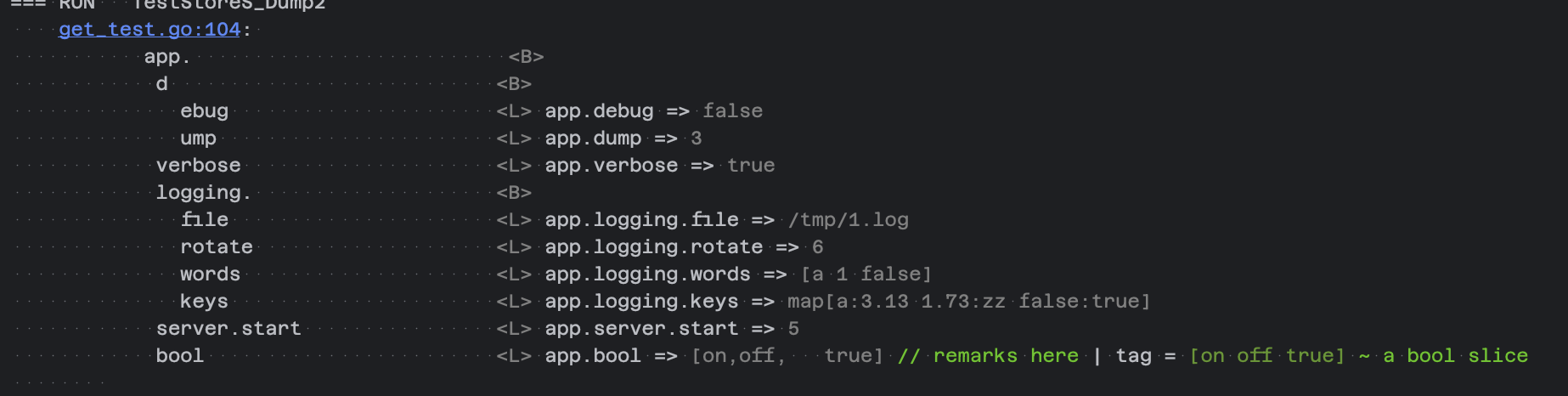
> `<B>` is branch, `<L>` is leaf.
>
> Leaf node contains data, comment, description and tag (any value).
>
> To speed up the tree, any delimiter char is a part of the path.
The `store` provides advanced APIs to extract the typed data from some a node,
```go
iData := conf.MustInt("app.logging.rotate")
stringData := conf.MustString("app.logging.rotate")
debugMode := conf.MustBool("app.debug")
...
```
The searching tools are also used to locate whether a key exists or not:
```go
found := conf.Has("app.logging.rotate")
node, isBranch, isPartialMatched, found := conf.Locate("app.logging.rotate")
t.Logf("%v | %s | %v | | %v, %v, found", node.Data(), node.Comment(), node.Tag(), isBranch, isPartialMatched, found)
```
`Locate` is a more friendly `Has` test for the developers when they want to inspect more extra information after searching.
For more information, browse these public sites:
- <https://pkg.go.dev/github.com/hedzr/store>
- <https://github.com/hedzr/store>
- Check out the codes in test source files
To see the recently changes at [CHANGELOG](https://github.com/hedzr/store/blob/master/CHANGELOG).
> Since v1.1.0, unexported struct ptr (*storeS) removed from `Store` API.
>
> These apis changed to:
>
> - `Clone() (newStore Store)`
> - `Dup() (newStore Store)`
> - `WithPrefix(prefix ...string) (newStore Store)`
> - `WithPrefixReplaced(newPrefix ...string) (newStore Store)`
>
> Since v1.2.0, the prototypes of `Locate`/`Query` are changed.
>
> - an extra `kvpair` will be returned if there is `:ident` in trie path and matched ok.
> - support these url var matching: "/:id/", "/*filepath"
>
> For example, matching `/hello/bob` on a router path pattern `/hello/:name` will get `kvpair = {"name":"bob"}`, and `/search/any/thing/here` on pattern `/search/*keywords` will get `kvpair = {"keywords":"any/thing/here"}`.
>
> Since v1.2.5, `SetTTL(path, ttl, callback)` added.
> Since v1.2.8, `SetTTLFast(node, ttl, callback)` added.
> Since v1.2.8, `SetEx(path, val, callback)` added.
> Since v1.3.0, moved the minimal toolchain to go1.23.7.
> Since v1.3.55, moved the minimal toolchain to go1.24.5.
Using store as the core of a http router is possible. Since v1.2 we added builtin http route param support (like `:user`).
Using [hedzr/store](https://github.com/hedzr/store) as a in-memory Cache provider is possible. Since v1.2.5 we added `SetTTL` to reset the data of a node (by key) to zero value. You can inject your codes to drop the key or whatever else.
## More Features
The `store` gives many advanced features from out of the box, but the relative documents are not enough. We will try our best to fill more documentation at a certain point in the future.
In short, the `store` can load the data from a provider which will load from its external source, which data will be decoded by a codec decoder.
Once your configuration data is loaded or inserted into the store manually, you can read them at any time, in any way.
That is, the original items can be extracted with a different data type if they can convert smoothly. For example, a string item `3d3h3s` can be got as a `time.Duration` value (via `MustDuration(path)`).
In totally:
- access fastly to the hierarchical tree data
- app configurations management
- load app configs from external sources
- various codec translators and source providers
- merge config fragment
- save the modifications to alternated external source
- see [cmdr-loaders](https://github.com/hedzr/cmdr-laoders)
- `$(PWD)/.app.toml` is the target
- standalone in-memory key-value pair
- as a in memory cache provider
- as a kernel of a http-router
- highly customizable
### Retrieve Node Data
A config entry, so-called as a node (in our Trie-tree), can be retrieved as a typed value:
```go
func ExampleStoreS_Get() {
trie := newBasicStore()
fmt.Println(trie.MustInt("app.dump"))
fmt.Println(trie.MustString("app.dump"))
fmt.Println(trie.MustBool("app.dump")) // convert 3 to bool will get false, only 1 -> true.
// Output:
// 3
// 3
// false
}
func newBasicStore(opts ...Opt) *storeS {
conf := New(opts...)
conf.Set("app.debug", false)
conf.Set("app.verbose", true)
conf.Set("app.dump", 3)
conf.Set("app.logging.file", "/tmp/1.log")
conf.Set("app.server.start", 5)
ss := conf.WithPrefix("app.logging")
ss.Set("rotate", 6)
ss.Set("words", []any{"a", 1, false})
return conf
}
```
### Extract A Subset
`GetM(path, opts...) map[string]any` is a power tool to extract the nodes as a map, which has the flattened keys. The extracted result looks like:
```bash
store_test.go:150: whole tree: map[app.debug:false app.dump:3 app.logging.file:/tmp/1.log app.logging.rotate:6 app.logging.words:[a 1 false] app.server.start:5 app.verbose:true]
store_test.go:160: app.logging sub-tree: map[app.logging.file:/tmp/1.log app.logging.rotate:6 app.logging.words:[a 1 false]]
```
The test code is:
```go
func TestStore_GetM(t *testing.T) {
conf := newBasicStore()
m, err := conf.GetM("")
if err != nil {
t.Fatalf("wrong in calling GetM(\"\"): %v", err)
}
t.Logf("whole tree: %v", m)
// filter by a functor
m, err = conf.GetM("", WithFilter[any](func(node radix.Node[any]) bool {
return strings.HasPrefix(node.Key(), "app.logging.")
}))
if err != nil {
t.Fatalf("wrong in calling GetM(\"\"): %v", err)
}
t.Logf("app.logging sub-tree: %v", m)
}
```
`GetM("")` can extract the whole tree, and `GetM("app.logging")` extract that subtree.
With filter functor, you can extract `app.logging` subtree by `GetM("", WithFilter[any](func(node radix.Node[any]) bool {
return strings.HasPrefix(node.Key(), "app.logging.")
})))`.
### Extract Subtree Into Struct
`GetSectionFrom` makes extracting to struct easier. For example,
```go
func TestStore_GetSectionFrom(t *testing.T) {
conf := newBasicStore()
conf.Set("app.logging.words", []any{"a", 1, false})
conf.Set("app.server.sites", -1)
t.Logf("\nPath\n%v\n", conf.Dump())
type loggingS struct {
File uint
Rotate uint64
Words []any
}
type serverS struct {
Start int
Sites int
}
type appS struct {
Debug int
Dump int
Verbose int64
Logging loggingS
Server serverS
}
type cfgS struct {
App appS
}
var ss cfgS
err := conf.GetSectionFrom("", &ss) // extract the whole tree
t.Logf("cfgS: %v | err: %v", ss, err)
assertEqual(t, []any{"a", 1, false}, ss.App.Logging.Words)
assertEqual(t, -1, ss.App.Server.Sites)
if !reflect.DeepEqual(ss.App.Logging.Words, []any{"a", 1, false}) {
t.Fail()
}
}
```
> TODO: Transferring a struct into the `Store` isn't in our plan yet.
### Light-weight Sub-tree
The `store` has a dead lightweight subtree accessor. By using `WithPrefix` or `WithPrefixReplaced`, you can construct a subtree accessor and read/write a node:
```go
func TestStore_WithPrefix(t *testing.T) {
trie := newBasicStore()
t.Logf("\nPath\n%v\n", trie.Dump())
assertEqual(t, 6, trie.MustGet("app.logging.rotate"))
conf := trie.WithPrefix("app")
assertEqual(t, 6, conf.MustGet("logging.rotate"))
conf = conf.WithPrefix("logging")
assertEqual(t, 6, conf.MustGet("rotate"))
conf = trie.WithPrefixReplaced("app.logging")
assertEqual(t, 6, conf.MustGet("rotate"))
}
```
### Easily Cutting
By using `SetPrefix(prefix)`, a `store` and its whole subtree can be moved or associated with a new hierarchical tree structure.
By using `Dup` or `Clone`, and `Merge`, the `store` can be cut and layout.
### Split key with delimiter
If a key contains delimiter, it will be split and insert into the `Store`. Technically, the inserter doesn't do special stuff for this key, but the getter will access the tree path separated by the delimiter char.
So when you're loading a YAML file (or others), the dotted key can make the file consicer:
```yaml
app.demo.working: "~/demo"
```
It equals
```yaml
app:
demo:
working: "~/demo"
```
This feature is builtin and cannot disable, due to we have a Trie-tree store and the node is always recognized at extracting.
A side effect is, when you're using a float-point number as a key, that will have matters. Our tip is, don't do that.
### Decompound Map
The data can be split and orchestrated into tree structure when you're inserting a map.
This feature works when a provider is loading its external source. `Set(k, v)` doesn't decompound anything in `v`. But `Merge(k, m)` does:
```go
func TestDecompoundMap(t *testing.T) {
conf := newBasicStore()
conf.Set("app.map", false) // ensure key path 'app.map' has already existed
// and now merge a map into the point/node
err := conf.Merge("app.map", map[string]any{
"k1": 1,
"k2": false,
"m3": map[string]any{
"bobo": "joe",
},
})
if err != nil {
t.Fatalf("Merge failed: %v", err)
}
assert.Equal(t, int(1), conf.MustGet("app.map.k1"))
assert.Equal(t, false, conf.MustGet("app.map.k2"))
assert.Equal(t, "joe", conf.MustGet("app.map.m3.bobo"))
}
```
Of course, it shall be a valid deep `map[string]any`.
### Decompound Slice
A slice can be decompounded once you enabled `WithStoreFlattenSlice(true)`.
It works for loading an external source, similar like Decompounding Map.
<details><summary>See the sample code for collapsed sections</summary>
For example:
```go
func TestHjson(t *testing.T) {
s := store.New()
parser := hjson.New()
if err := s.Load(context.TODO(),
store.WithStorePrefix("app.hjson"),
store.WithCodec(parser),
store.WithProvider(file.New("../testdata/6.hjson")),
store.WithStoreFlattenSlice(true),
); err != nil {
t.Fatalf("Load failed: %v", err)
}
t.Logf("\n%-32sData\n%v\n", "Path", s.Dump())
assert.Equal(t, `r.Header.Get("From")`, s.MustGet("app.hjson.messages.0.placeholders.0.expr"))
assert.Equal(t, `r.Header.Get("User-Agent")`, s.MustGet("app.hjson.messages.1.placeholders.0.expr"))
}
```
The supplied hjson file has the following contents:
```json5
{
"language": "zh",
"messages": [
{
"id": "Hello {From}!",
"message": "Hello {From}!",
"translation": "",
"placeholders": [
{
"id": "From",
"string": "%[1]s",
"type": "string",
"underlyingType": "string",
"argNum": 1,
"expr": "r.Header.Get(\"From\")"
}
]
},
{
"id": "Do you like your browser ({User_Agent})?",
"message": "Do you like your browser ({User_Agent})?",
"translation": "",
"placeholders": [
{
"id": "User_Agent",
"string": "%[1]s",
"type": "string",
"underlyingType": "string",
"argNum": 1,
"expr": "r.Header.Get(\"User-Agent\")"
}
]
}
]
}
```
</details>
### Notable Nodes
Different from other configuration managers, the store is not only a memory key-value store. The nodes in store are both notable and taggable.
```go
conf.Set("debug", false)
conf.SetComment("debug", "a flag to identify app debug mode", "remarks here")
conf.SetTag("debug", map[string]any{
"handler": func(){},
})
node, _, _, found := conf.Locate("debug")
if found {
t.Log(node.Tag(), node.Description(), node.Comment())
}
t.Log(conf.Dump())
```
`Dump()` will produce the detailed output.
### Walk The Whole Tree
`Walk(path)` gives a way to iterator the `Store`.
```go
func TestStore_Walk(t *testing.T) {
var conf Store = newBasicStore()
conf.Walk("", func(path, fragment string, node radix.Node[any]) {
t.Logf("%v / %v => %v", path, fragment, node)
})
}
// Output:
// / => &{[] [0xc0000e23f0] <nil> <nil> 0}
// app. / app. => &{[97 112 112 46] app. [0xc0000e2480 0xc0000e2510 0xc0000e26c0 0xc0000e2750] false <nil> 0}
// app.d / d => &{[100] app.d [0xc0000e25a0 0xc0000e2630] false <nil> 0}
// app.debug / ebug => &{[101 98 117 103] app.debug [] false <nil> 13}
// app.dump / ump => &{[117 109 112] app.dump [] 3 <nil> 13}
// app.verbose / verbose => &{[118 101 114 98 111 115 101] app.verbose [] true <nil> 13}
// app.logging. / logging. => &{[108 111 103 103 105 110 103 46] app.logging. [0xc0000e2870 0xc0000e2900 0xc0000e2990] /tmp/1.log <nil> 0}
// app.logging.file / file => &{[102 105 108 101] app.logging.file [] /tmp/1.log <nil> 13}
// app.logging.rotate / rotate => &{[114 111 116 97 116 101] app.logging.rotate [] 6 <nil> 13}
// app.logging.words / words => &{[119 111 114 100 115] app.logging.words [] [a 1 false] <nil> 13}
// app.server.start / server.start => &{[115 101 114 118 101 114 46 115 116 97 114 116] app.server.start [] 5 <nil> 13}
```
As a feature based on Trie-tree, `Walk("app")` will walk from the parent of `app.` node. And `Walk("app.")` will walk from the `app.` node.
Like `GetM`, passing "" will walk from the top-level root node.
### Modified State
Each node has a modified state, so we can extract them from the `Store`:
```go
func (s *loadS) Save(ctx context.Context) (err error) { return s.trySave(ctx) }
func (s *loadS) trySave(ctx context.Context) (err error) {
if s.codec != nil {
var m map[string]any
if m, err = s.GetM("", WithFilter[any](func(node radix.Node[any]) bool {
return node.Modified()
})); err == nil {
var data []byte
if data, err = s.codec.Marshal(m); err == nil {
switch fp := s.provider.(type) {
case OnceProvider:
err = fp.Write(data)
default:
err = ErrNotImplemented
}
if errors.Is(err, ErrNotImplemented) {
if wr, ok := s.provider.(io.Writer); ok {
_, err = wr.Write(data)
}
}
}
}
}
return
}
```
We assume the user calling `Set(k, v)` will cause modified state was set to true. And app loading and merging to the `Store` at startup will be treated as initial state, so the modified state keeps unset (i.e., false).
### Provider for External Source
`Provider`s could be used to describe an external source, such as file, env, or consul and vice versa.
`Codec`s are used to describe how to decode a streaming input loaded by Provider, such as yaml, toml, json, hcl, etc.
A loading logic typically is:
```go
func TestTOML(t *testing.T) {
s := store.New()
parser := toml.New()
if err := s.Load(context.TODO(),
store.WithStorePrefix("app.toml"),
store.WithCodec(parser),
store.WithProvider(file.New("../testdata/5.toml")),
store.WithStoreFlattenSlice(true),
); err != nil {
t.Fatalf("Load failed: %v", err)
}
t.Logf("\n%-32sData\n%v\n", "Path", s.Dump())
Frequently Asked Questions
What is hedzr/store?
hedzr/store is a Configuration library for the Go programming language. Extensible, high-performance configuration management library, optimized for hierarchical data
How do I install hedzr/store?
Install hedzr/store with the Go module system using `go get hedzr/store`. Check the repository for the current installation instructions.
What category does hedzr/store belong to?
hedzr/store is listed under Configuration, specifically Configuration.